
Reviewed · TOURS IN OAHU
Honolulu Downtown Walking Tour
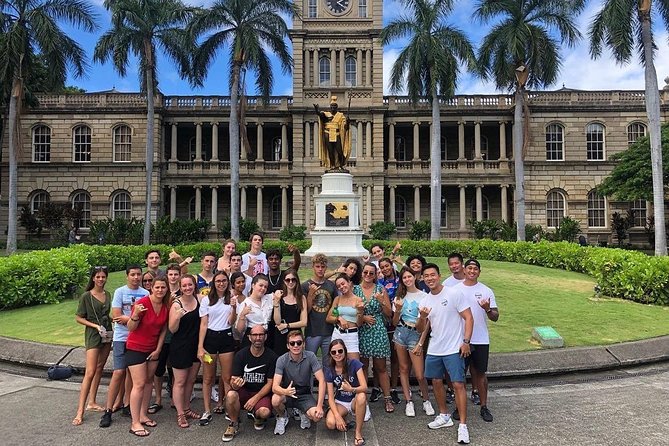
At the King Kamehameha statue, this tour begins with the story of how Hawaiians formed a nation, then follows the monarchy’s history through the heart of downtown Honolulu. In a little over an hour, you get a useful first look at landmarks that are easy to pass without understanding.
I like two things in particular: the focus on Hawaiian rulers and the political changes that shaped the islands, and the way guides such as Susan connect names, buildings, and events into a clear timeline. At $5 per person, it is also an unusually affordable way to get an introduction to the city.
One consideration: this is a talk-focused walk. The route covers less than half a mile according to the tour provider, and much of the time is spent standing as the guide explains each stop. If you want a long, brisk walk or extended time inside historic buildings, this may not be the right fit.
Key points to know before you go
- The route centers on Honolulu’s royal and government district, including Iolani Palace, the State Capitol, and Kawaiahaʻo Church.
- Hawaiian history is the main event, from Polynesian origins and Kamehameha’s unification to the end of the monarchy and Hawaii’s path to statehood.
- Guide Susan is frequently praised for her storytelling, clear explanations, and willingness to answer questions.
- Expect more listening than walking: the route is short, with several stops for talks.
- The tour starts at 9:00 am in front of the King Kamehameha statue, outside Waikiki, and returns to the same meeting point.
- The listed price is $5 per person, with a maximum group size of 30.
A short route through a long Hawaiian story
Downtown Honolulu packs an unusually large amount of Hawaiian political history into a compact area. This tour uses its statues, government buildings, church, and royal sites as a sequence of markers in a story that can otherwise feel scattered across books and island visits.
The central thread is the change from an independent Hawaiian kingdom to a US territory and then a state. The guide also covers Polynesian and Austronesian origins, the unification of the islands under Kamehameha, and the monarchs who followed. That makes the walk a useful primer if you are new to Hawaiian history, or a way to put familiar names and places into order.
The stops sit within a short radius. The tour information gives a route of less than half a mile, while some descriptions of the experience refer to a circuit of about 1.5 kilometers. Either way, this is not a strenuous hike. The short distance leaves room for the guide to explain the meaning of each site rather than hurry you from one landmark to another.
That trade-off is the key to setting expectations. People who want an easy introduction and enjoy a good historical explanation are likely to get more from the tour than those who measure a walking tour by how many miles they cover.
A few more Oahu tours around Oahu worth a look
- Self guided Hike Trail to Nature Walk & Waterfall
★ 4.5 · 283 reviews - Honolulu Haunts: Ghosts and Spirits Walking Tour
★ 4.2 · 169 reviews - Kualoa Ranch – Horseback Walking Tour
★ 4.0 · 145 reviews
Starting at the King Kamehameha statue
Meet in front of the King Kamehameha statue at 447 South King Street. The listed start time is 9:00 am, and the guide wears a white or black shirt with the Hawaii Free Tour logo. The location is in downtown Honolulu, not Waikiki, so plan for the fact that you will need to reach the city center before the morning start.
The statue is a fitting place to begin. The first discussion sets out the origins of the Hawaiian people and the formation of the first and only Hawaiian nation. Kamehameha’s role in unifying the islands gives the later stops a clear point of reference: you are not just looking at buildings, but following the fortunes of a kingdom and its rulers.
The meeting point is also practical. You can spot the statue and the guide’s logo shirt without needing to find a ticket desk or enter a building first. Confirmation comes at booking, and the tour is offered in English with a mobile ticket.
Aliiolani Hale and Iolani Palace: the monarchy in view
Aliiolani Hale appears in the route alongside the royal landmarks. The itinerary does not assign it a separate timed talk, but its place in the civic and royal district helps frame the tour’s discussion of Hawaii’s government and monarchy.
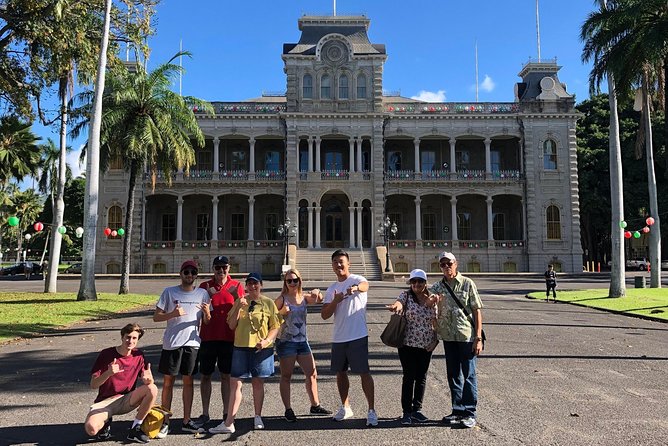
Iolani Palace is the main royal landmark on the walk. Here the guide talks about different monarchs and the role played by people from Europe and the US mainland in shaping Hawaii’s past. The subject is not simply a list of rulers. It is a chance to follow the shifting pressures on the kingdom and understand why the country’s political story is central to the city’s architecture.
The palace stop is listed at about 15 minutes. That is enough for a focused outdoor explanation, not a full palace visit. Admission to the listed stops is free, but the tour details do not promise entry to the buildings. If you want to spend time inside Iolani Palace, treat that as a separate visit rather than assuming it is included in this walk.
This stop will matter most if you want context before exploring the island on your own. The guide’s explanations can help make later visits to Hawaiian cultural sites, museums, or historical landmarks easier to follow.
The State Capitol and the shift to US rule
At the Hawaii State Capitol, the story moves from the monarchy to the political changes that made Hawaii a US territory and then a state. The stop is listed for about 15 minutes, giving the guide time to lay out the transition in a way that connects the earlier royal history with modern Hawaii.
I find this part of the route valuable because it prevents the tour from ending with the kingdom’s past as if nothing followed. The Capitol is a visual cue for the present-day government, while the explanation links it to the major changes in sovereignty and political status.
The focus is historical rather than a government-building visit. No interior tour is specified, so expect a discussion at the landmark rather than a guided visit through offices or chambers. The same principle applies throughout: the value lies in the guide’s account of what you are seeing, not in admission to each site.
Same island, a different kind of day out:
- Oahu Grand Circle Island and Haleiwa Tour: 9-Hr Deluxe Experience
★ 5.0 · 17,387 reviews - Oahu: Grand Tour Around Island 16 Locations plus Snorkeling
★ 5.0 · 8,669 reviews - Parasailing Experience in Waikiki, HI
★ 5.0 · 7,692 reviews - Salute to Pearl Harbor Including USS Arizona
★ 4.5 · 7,433 reviews
Kawaiahaʻo Church and Honolulu’s civic center
Kawaiahaʻo Church adds a different kind of landmark to the route. The tour allows about 10 minutes here, and its presence broadens the story beyond palaces and state institutions. You get a chance to consider the role of religious life in the history of Honolulu as the city and its leadership changed.
The route also includes Honolulu City Hall and the Hawaii State Library. These stops are named in the itinerary, though no separate durations are given for them. Taken together with Aliiolani Hale and the Capitol, they show how much of the city’s civic life sits close to the royal sites.
For a short walk, that range is useful. You move between political, religious, and public landmarks without spending the morning crossing town. The drawback is that several stops may feel like brief pauses in a longer conversation rather than individual visits. If you prefer to explore a church or public building at your own pace, you may want to return later.
King Lunalilo’s garden and mausoleum
The final named stop is King Lunalilo’s Mausoleum, with about 15 minutes set aside for King Lunalilo’s garden and burial. It offers a more personal note after the tour’s broader account of monarchy, unification, and political change.
The stop gives the guide room to discuss another Hawaiian ruler and the place of royal burial in the city’s historical memory. The tour description does not give further detail about the garden or mausoleum, so it is best to approach this as a guided historical stop rather than expect a long grounds visit.
From here, the activity ends back at the King Kamehameha statue. Returning to the start point makes the tour easy to fit into a morning, but it also means you should plan your next activity from downtown rather than assume the walk finishes in Waikiki.
Susan’s storytelling is the tour’s strongest asset
Many of the tour’s most praised qualities come down to the guide. Susan is repeatedly described as warm, engaging, and strong at explaining Hawaiian history in plain language. Her background is also associated with academic and museum work, and she is often credited with answering questions and connecting events to the people involved.
That matters on a tour with a lot of standing. A short route can feel slow if the guide’s explanations are dry or hard to follow. Here, the appeal is the storytelling: a clear chronology, memorable anecdotes, and enough detail to make the landmarks more than photo stops. Some visitors specifically value the stories about Hawaiian royalty and the personalities behind the history.
The tour is also a good place to ask questions. If a name or political change leaves you unsure, the guide’s answers can help you follow the chain of events. You do not need to arrive with a background in Hawaiian history, though an interest in the subject will make the stops more rewarding.
Still, the experience depends in part on the guide and the group’s pace. One less enthusiastic account felt there was too much talking and too little walking, and noted fewer stops than expected. The route is short by design, so if you want movement more than interpretation, that is a fair concern.
Is $5 a good value?
At $5 per person, the tour is priced as an accessible introduction rather than a full-day excursion. You get a local guide, a short guided route, and a connected account of major historical landmarks. The cost is modest enough that it can make sense even if you are only partly sure that a history walk is your style.
The value is less about the distance covered and more about what you learn along the way. Without a guide, you can see the statue, palace, church, and Capitol, but the sequence and political context may not be obvious. A guide turns those separate sites into a narrative, which is especially useful if this is your first visit to Honolulu.
A low price does not mean you should expect a lengthy tour or access to every building. The listed duration is about 70 minutes, though some accounts of the walk describe it lasting closer to 80 or 90 minutes. Leave a little flexibility afterward, especially if you want time to ask questions or linger at a stop.
The group can include up to 30 people. That is a manageable cap for a short city walk, though a larger group can make it harder to hear from farther back. Arriving on time and staying near the guide will help you follow the explanations.
Practical details that shape the morning
The tour begins at 9:00 am and ends where it starts. The location is near downtown Honolulu and outside Waikiki, so factor in the transfer from your accommodation. Public transportation is nearby, and the activity is considered suitable for most participants. Service animals are allowed.
The walk is accessible in the ordinary sense of being short and not physically demanding, but it does involve standing during explanations. If you have trouble standing for stretches, keep that in mind. The route’s brevity is a benefit for visitors with limited time or those who want an easy outing, but it does not remove the stop-and-listen format.
The experience requires good weather. If poor weather causes a cancellation, you are offered another date or a full refund. You can cancel for a full refund up to 24 hours before the start time; changes or cancellations inside that window are not accepted.
The tour is booked, on average, about 30 days ahead. That is a useful planning clue if you have a fixed morning in Honolulu. The group limit is 30, and the repeated interest in Susan’s tours suggests it is sensible not to leave booking until the last moment if this particular date matters to you.
Who should book the Honolulu Downtown Walking Tour?
I would choose this tour if you want a compact, affordable introduction to Hawaiian history and would rather hear a clear account than read plaques on your own. It suits first-time visitors, history buffs, and anyone with a limited window in Honolulu. It can also work well early in a trip, giving you names and events to recognize as you explore elsewhere on Oahu.
It is less suited to someone hoping for a long urban walk, a fast-moving sightseeing loop, or interior visits to the palace and other buildings. The route is short, and the guide’s talk is the central feature. If that sounds like a good use of a morning, the $5 price makes the decision easy. If you would rather keep moving, you may prefer to visit the landmarks independently.
FAQ
How long does the Honolulu Downtown Walking Tour last?
The stated duration is about 1 hour and 10 minutes. Some descriptions of the experience place it closer to 1 hour and 20 minutes or 1 hour and 30 minutes, so leave a little extra time.
Where does the tour start and finish?
It starts in front of the King Kamehameha statue at 447 South King Street in Honolulu. The activity ends back at the meeting point.
What time does the tour begin?
The listed start time is 9:00 am.
How much does the tour cost?
The listed price is $5 per person.
What language is the tour offered in?
The tour is offered in English.
How many people can join the tour?
The maximum group size is 30 travelers.
What happens if bad weather cancels the tour?
If the activity is canceled due to poor weather, you will be offered a different date or a full refund.
Just added around Oahu
- Private Turtle Canyon Snorkel Tour – Up to 6 Passengers★ 4.5 · 29 reviews
- Private Off-Road Adventure Tour★ 4.5 · 52 reviews
- Private Off Road Explorer’s Tour★ 5.0 · 4 reviews
- Group Surf Lesson with Videos and Photos★ 5.0 · 69 reviews
- Private Surf Lesson for 3-5 People in North Shore Oahu★ 5.0 · 13 reviews
- Private Group Surf Lesson for 4 by Waikiki Beachboys at the Royal★ 4.5 · 19 reviews
- Private Deep Sea Full-Day Fishing Charter in Hawaiian Waters★ 4.0 · 5 reviews
- Private Group SUP Lessons by Waikiki Beachboys at the Royal★ 4.5 · 6 reviews
Tours in Oahu, compared.


Waikiki Trolley Hop-On Hop-Off Tour of Honolulu
Read our review →


Waikiki Trolley Blue Line Coastline & Local Grindz Hop-on Hop-off
Read our review →
Oahu Circle Island Tour with Waimea Waterfall
Read our review →
Oahu’s North Shore: 8-Line Zipline Adventure
Read our review →
Hidden Gems of Oahu Circle Island Tour with Byodo In Temple
Read our review →Browse the lists this tour appears in