

Reviewed · TOURS IN OAHU
Downtown Honolulu Self Guided Walking Audio Tour
Honolulu’s downtown tells a story of a kingdom changing under pressure. This walk connects royal landmarks, government buildings, and memorials, tracing the rise of Kamehameha, the rule of Queen Liliʻuokalani, and the political struggle that ended the Hawaiian monarchy.
I like two things in particular: the audio brings context to sites you might otherwise pass without understanding, and the route lets you set your own pace. There are more than 23 stories over roughly 1.6 miles, with no group to keep up with and no guide to wait for.
The main catch is practical, not historical: you need to download a separate app and enter a password before you start. Some people find that setup confusing, so do it on a strong connection before heading out. Honolulu’s afternoon heat is another good reason to walk in the morning.
- A route from Aloha Tower to the Queen Liliʻuokalani Statue: The walk finishes near the heart of the Hawaiian monarchy’s story.
- More than 23 audio stories: Expect history at major landmarks, with extra material available for topics you want to explore further.
- About 1.6 miles and one to two hours: You can pause, take photos, or break for a snack without losing your place.
- A blend of royal, civic, and artistic sites: See the Kamehameha statue, Iolani Palace, the State Capitol, and Isamu Noguchi’s Sky Gate.
- Offline playback after download: The tour works without a cell or Wi-Fi connection once it is on your phone.
- $9.99 with lifetime access: Use it on a later trip too, though entry tickets and reservations are not included.
A royal story begins at Aloha Tower

The tour starts at Aloha Tower Marketplace and heads into a downtown shaped by the Hawaiian Kingdom, its leaders, and the political forces that sought to replace it. At $9.99, you get a route and an audio guide rather than a live guide or a ticket to an attraction. That makes the value depend on how much you enjoy listening to stories while walking and how readily you use a phone app.
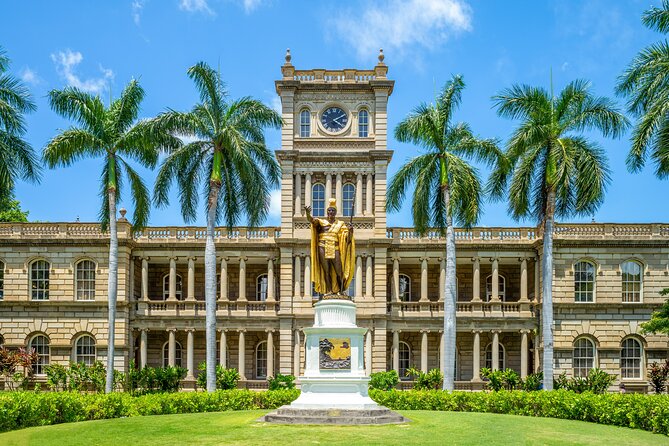
The first listed stop is the statue of King Kamehameha. Its dramatic presence sets up a story of 18th-century battles among chiefs seeking control of the islands. The audio describes Kamehameha as an intimidating warrior, then gives you a reason to look beyond the statue itself: this was a period of conflict and shifting power, not simply a procession of royal names.
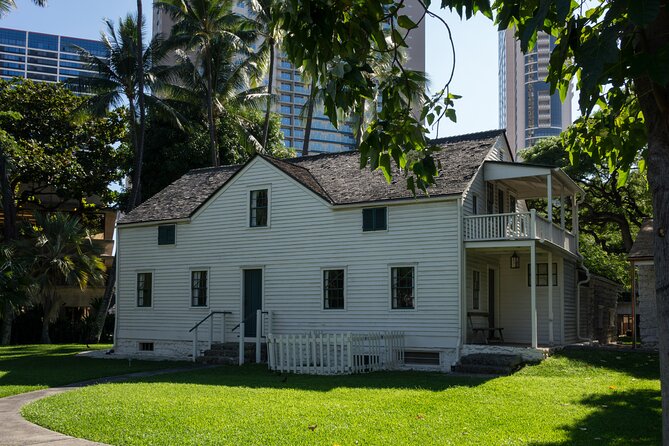
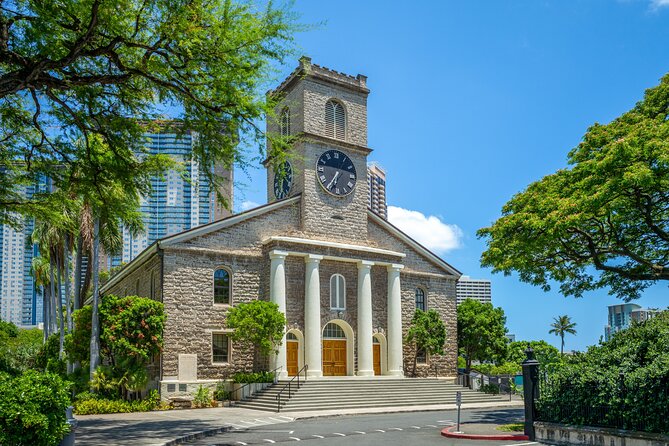
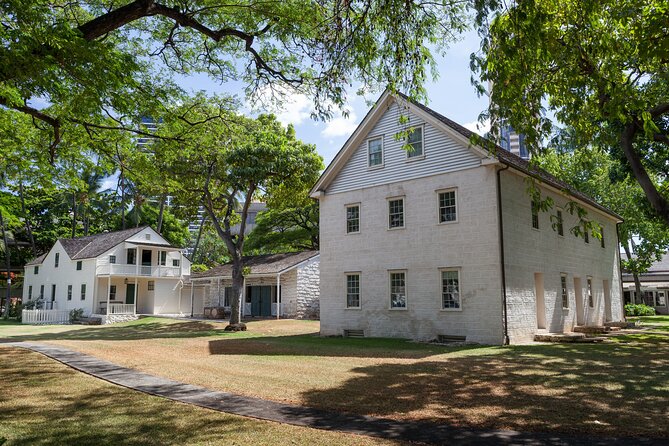
From there, the route introduces Kawaiahaʻo Church, once the national church of the Hawaiian Kingdom. The tour gives this stop about ten minutes, enough time to listen and take in the site without turning the walk into a long visit. It also includes a museum stop focused on objects from Hawaii’s missionary period. The supplied route information does not name the museum, so check the app’s map and audio cues as you approach rather than relying on a particular name.
These early stops help explain why Honolulu’s landmarks matter together. A church, a museum, and a royal statue are not isolated attractions here; each points to a different part of the island’s political and cultural change.
The civic buildings tell the next chapter
At Aliʻiōlani Hale, the audio links architecture to a change in purpose. Kamehameha V originally planned the building as a palace for Hawaiian monarchs. King Kalākaua later converted it to government offices. That change makes the building a useful pause in the tour’s larger story: the sites around you have served different roles as power shifted.
Honolulu Hale, the city hall, brings the narrative to Kalākaua’s return from a world tour in 1881. Hawaiians decorated the city and hung a welcome banner across Honolulu Harbor. But celebration did not mean political calm. The tour connects this moment to the Reform Party, a mostly American political party that gained influence after the 1875 Reciprocity Treaty.
This is where the audio format earns its keep. Without context, civic buildings can look like handsome backdrops on a walk. With the story, they become part of a sequence: a king returns to public acclaim while others plot against his authority. You can listen, look at the building, and then move on when you are ready.
The route also includes the Patsy Takemoto Mink statue and memorial. Mink was a third-generation Japanese American who grew up in Hawaii. Her presence widens the walk beyond royal history and the 19th-century struggle over the kingdom. It gives you a more recent figure to consider and a reminder that Honolulu’s public history includes political leadership from more than one era.
A few more Oahu tours around Oahu worth a look
- Self guided Hike Trail to Nature Walk & Waterfall
★ 4.5 · 283 reviews - Honolulu Haunts: Ghosts and Spirits Walking Tour
★ 4.2 · 169 reviews - Honolulu Downtown Walking Tour
★ 5.0 · 149 reviews
Pause at Sky Gate and the State Capitol
At Sky Gate, artist Isamu Noguchi’s work asks for a different kind of attention. Its black, bending tubes may suggest a web, an animal, or simply an abstract shape. The audio shares Noguchi’s description of the work as an evocation of Hawaii’s skies. You do not need to settle on one interpretation; part of the pleasure is looking at it, then hearing how the artist framed it.
The Hawaii State Capitol shifts the focus back to government. Before the Capitol was built, ʻIolani Palace served as the seat of government. That detail prepares you for the palace later in the route and makes the buildings feel connected rather than like separate stops on a checklist.
Near the Capitol, the Eternal Flame Memorial honors those who died in the attack on Pearl Harbor on December 7, 1941. It is a somber stop, and the audio places it within the broader history of Honolulu rather than treating it as a quick photo opportunity. Give yourself a moment here if you want one; the self-guided format lets you pause without holding up a group.
The route’s combination of art, government, and memorial sites is one of its strengths. The subject changes from stop to stop, but the central thread remains how public places preserve memory and power. If you prefer a walk devoted to one narrow theme, this may feel broad. If you like moving through different layers of a city’s past, the variety helps keep the route engaging.
Washington Place and the royal household

Washington Place was once the home of Queen Liliʻuokalani. The two-story mansion sits back from the road, and the audio draws attention to its place in the queen’s life. It is an important transition from the public buildings and political maneuvering of earlier stops to the personal story of a monarch whose authority was under threat.
Iolani Barracks offers another direct link to the overthrow of the Hawaiian monarchy. Before Dole and the Annexation Club completed their coup against Queen Liliʻuokalani, the barracks housed her Royal Guard. The audio helps you see the building not merely as a historic structure, but as part of the machinery and setting of a political crisis.
Then comes ʻIolani Palace, dating to 1879 and described on the tour as the only royal palace in the United States. It is one of the route’s most consequential stops. The palace served as a royal home and, before the State Capitol, as the seat of government. Its place in the walk brings together the story of Hawaiian sovereignty, the monarchy, and the later political changes that reshaped the islands.
The tour does not include admission passes, entry tickets, or reservations. That matters if you hope to go inside any attraction: the $9.99 buys the audio route, not access to buildings. The supplied information does not specify which sites require reservations or their current entry terms, so check separately if you plan to visit interiors rather than view the landmarks from the route.
Finishing with Queen Liliʻuokalani
The walk ends at the statue of Queen Liliʻuokalani. The audio describes how, as the 20th century progressed, she withdrew from public life and lived at Washington Place, where Native Hawaiians continued to visit her. It also shares her enduring devotion to her people.
That finish gives the tour an emotional center. The story does not stop at political defeat; it points to the continuing bond between the queen and those who regarded her as their sovereign. After hearing about the palace, the guard, and the coup, the statue feels less like a final landmark and more like the closing page of the route’s central narrative.
The end point is listed as the Queen Liliʻuokalani Statue, at 21024001, Honolulu, Hawaii. The start and finish are not the same, so plan your next move from the end of the walk. The tour description notes that the area is near public transportation, but it does not specify a particular route or stop.
Same island, a different kind of day out:
- Oahu Grand Circle Island and Haleiwa Tour: 9-Hr Deluxe Experience
★ 5.0 · 17,387 reviews - Oahu: Grand Tour Around Island 16 Locations plus Snorkeling
★ 5.0 · 8,669 reviews - Parasailing Experience in Waikiki, HI
★ 5.0 · 7,692 reviews - Salute to Pearl Harbor Including USS Arizona
★ 4.5 · 7,433 reviews
How the audio app shapes the walk
This is a self-guided experience, not a scheduled tour with a person waiting at the start. After booking, you receive setup instructions and a password by email and text. Search for audio tour in your messages if the instructions are hard to locate. Download Action’s Tour Guide app, enter the password, and download the tour while you have a strong Wi-Fi or cellular connection.
Once downloaded, the map and audio work offline. At the start point, open the correct tour version for your starting place and direction. The first story should play when you reach its location, followed by audio cues as you walk. The hands-free, location-triggered design means you can keep your phone away more often, but the setup has to go smoothly first.
Bring headphones or earbuds. The tour is listed in English, and the app can be used on an iPhone running iOS 15 or later, an Android device running version 9 or later, or a GPS-equipped tablet with cellular connectivity. The password works on as many devices as the number of people booked. The tour information also suggests that couples can share one tour by splitting headphones, which is a simple way to reduce the per-person cost if you are comfortable listening together.
The audio earns its value when it is clear and easy to follow. The strongest elements of the experience are the historical storytelling and explicit walking directions. But setup is a real weak point for anyone who is not comfortable downloading apps, finding a confirmation message, and entering a code. Get the app ready before you leave your lodging, and contact support if playback or directions fail.
Timing, comfort, and value at $9.99
The advertised duration is one to two hours for a route of more than 1.6 miles and over 23 audio stories. That estimate gives you a useful baseline, but the actual time depends on how often you stop, listen to extra stories, take photos, or explore nearby sites. You can pause the audio, skip stories, and resume later, even across multiple days.
Start in the morning if you can. Honolulu can be very hot in the afternoon, and shade or air-conditioned buildings may become tempting detours. The self-paced format makes breaks easy, but heat can still make a long outdoor walk less comfortable. Carry water and leave room in your schedule rather than treating the one-to-two-hour estimate as a fixed appointment.
At $9.99 per person, the price is modest for a route with more than 23 stories and lifetime access. You can use the tour again on another trip, and the audio does not expire. That reuse makes the fee easier to justify if you visit Honolulu more than once or want to spread the walk across separate outings.
The price is less compelling if you want a live guide, dislike phone-based directions, or expect admission to be included. No attraction tickets or reservations are part of the package. The tour is best understood as a portable audio guide that adds context to a public walk, not as an all-inclusive sightseeing outing.
The overall rating provided is 3.7 from six ratings, a small sample with a mixed picture. The tour’s best potential is easy to understand: strong storytelling and precise directions can make a historic walk both informative and simple to follow. The risk is also clear: if app setup proves frustrating, you may lose time before the history even begins.
Who should take this walk

I would choose this tour if you want an independent introduction to downtown Honolulu and are interested in the Hawaiian monarchy, the changing role of government, and the city’s memorials. It is also a good fit if you like stopping when you want and prefer a phone-based guide to joining a group.
You may want a different approach if you need a guide to explain things in person, do not want to use an app, or are mainly looking for indoor visits. This route is built around walking between public landmarks, and admission is not included. Families and mixed-interest groups may appreciate being able to skip stories or take breaks, though the experience is still a walk of more than 1.6 miles.
I would book it for the route and the historical framing, then prepare the app before the day of the walk. Begin in the morning, bring earbuds, and allow extra time around the palace and the final statue. If you want a low-cost way to connect Honolulu’s royal sites with its civic history, this is a useful option. If app setup or afternoon heat would spoil the outing for you, plan accordingly before paying.
FAQ
How long is the walking tour?
The route is more than 1.6 miles long and takes about one to two hours. You can pause, skip stories, and take breaks at your own pace.
Where does the tour start and end?
It starts at Aloha Tower Marketplace, 1 Aloha Tower Drive, Honolulu. It ends at the Queen Liliʻuokalani Statue.
What language is the audio tour in?
The tour is offered in English.
Does the tour work without internet?
Yes. You need a strong Wi-Fi or cellular connection to download the tour first. After that, the app works offline.
Are attraction tickets or reservations included?
No. Entry tickets, attraction passes, and reservations are not included in the $9.99 price.
What do I need to use the tour?
You need Action’s Tour Guide app, the password sent after booking, and a compatible phone or GPS-equipped tablet. Headphones or earbuds are recommended.
Can I use the tour again later?
Yes. The tour has lifetime access with no expiry, so you can use it on another trip and start or pause it whenever you like.
More Audio Tours in Oahu
- Diamond Head Official Self-Guided Narrated Audio Tour
★ 3.0 · 212 reviews - Pearl Harbor Aviation Museum Ticket with Audio Tour and Shuttle
★ 4.5 · 58 reviews - Oahu Grand Circle Island Audio Driving Tour
★ 4.5 · 37 reviews - Self-Guided Audio Driving Tour in Oahu Hawaii
★ 4.5 · 30 reviews
Just added around Oahu
- Private Turtle Canyon Snorkel Tour – Up to 6 Passengers★ 4.5 · 29 reviews
- Private Off-Road Adventure Tour★ 4.5 · 52 reviews
- Private Off Road Explorer’s Tour★ 5.0 · 4 reviews
- Group Surf Lesson with Videos and Photos★ 5.0 · 69 reviews
- Private Surf Lesson for 3-5 People in North Shore Oahu★ 5.0 · 13 reviews
- Private Group Surf Lesson for 4 by Waikiki Beachboys at the Royal★ 4.5 · 19 reviews
- Private Deep Sea Full-Day Fishing Charter in Hawaiian Waters★ 4.0 · 5 reviews
- Private Group SUP Lessons by Waikiki Beachboys at the Royal★ 4.5 · 6 reviews
Tours in Oahu, compared.


Waikiki Trolley Hop-On Hop-Off Tour of Honolulu
Read our review →


Waikiki Trolley Blue Line Coastline & Local Grindz Hop-on Hop-off
Read our review →
Oahu Circle Island Tour with Waimea Waterfall
Read our review →
Oahu’s North Shore: 8-Line Zipline Adventure
Read our review →
Hidden Gems of Oahu Circle Island Tour with Byodo In Temple
Read our review →Browse the lists this tour appears in